
Weekly Investment Insights
Rocky Start to a New Year – Early Review of 1Q26
Key Takeaways:
- 1Q26 on pace to disappoint investors. Market Volatility Outlook.
- Economic growth was strong pre-Iran War.
- U.S. lags the rest of the world.
- Bonds impacted by inflation and hawkish central bank rhetoric.
- Energy rises the most since 1990.
Rocky Start to a New Year – Early Review of 1Q26
We realize today is not officially the end of 1Q26, and what this quarter has taught us is that anything can happen in a single trading day, let alone two. However, we wanted to provide an early look at what has shaped up to be a volatile and disappointing quarter for investors. Markets have navigated escalating tensions in the Middle East, surging energy prices, private credit fears, and hawkish central bank rhetoric. Prior to the war with Iran, economic growth kicked off 2026 on solid footing with manufacturing exiting a recession, homebuyers emerging, consumers spending, and the AI investment continuing. Below you will find an initial review of 1Q26 from an economic and market perspective.
- Inflation scare: Inflation at the producer and consumer level is moving further above the Fed’s target (2%). Core PCE (YoY) is growing 3.1% (YoY).
- Fed rate cuts off the table: The Fed left rates unchanged and noted inflation was a larger concern than the labor market. They also did not rule out rate hikes this year if inflation does not improve.
- Manufacturing expanding: The ISM Manufacturing Index posted its best back to back months since 2022 (Jan & Feb).
- Confidence weak but spending stable: Consumers kicked off 2026 spending at a solid pace but confidence has deteriorated on inflation and war fears.
- Labor uncertainty: The U.S. economy shed jobs in February but a major healthcare strike and weather drove the weakness.
Global Equities: U.S. lags.
The MSCI AC World Index is on pace to post its worst quarter since 3Q22. The war in Iran and surging energy costs are causing investors to reprice central bank rate cut expectations and reevaluate heightened valuations.
- U.S. lags rest of world. The S&P 500 is underperforming the MSCI AC World Index ex U.S. by the most since 1Q25. Tech and large cap growth are seeing the bulk of the weakness. The NASDAQ, Russell 1000 Growth Index and Dow Jones Industrial Average entered correction territory in 1Q26 (drop of 10% or more).
Global fixed income: Bonds weaker on inflation fears:
As of Friday, the Bloomberg Aggregate Index is on pace to drop for the first quarter since 4Q24. Hawkish central banks and inflation fears caused long term yields to rise for most of 1Q26.
- Interest rate risk matters: While the 10YR and 30YR Treasuries are declining sharply for the quarter 3 Mo Tbills and 2YR notes are slightly posititve.
- Credit fears emerge: Fears in private credit spread to high yield bonds which are on pace to post their worst quarter since 3Q22.
Commodities: Energy surges on war.
The Bloomberg Commodity Index is on pace to post its best quarter since 1Q22.
- Energy leads: The Bloomberg Energy Index is on pace to post its best quarter since 3Q90.
- Gold rallies but volatile: Gold is on pace to rally in 1Q26. However, gold came very close to bear market territory (a drop of 20% or more) as investors took profits with a strong dollar and higher interest rates.
LISTEN NOW: Markets With Megan
Your Economic and Market Detailed Recaps
- Unit labor costs surge to end 2025.
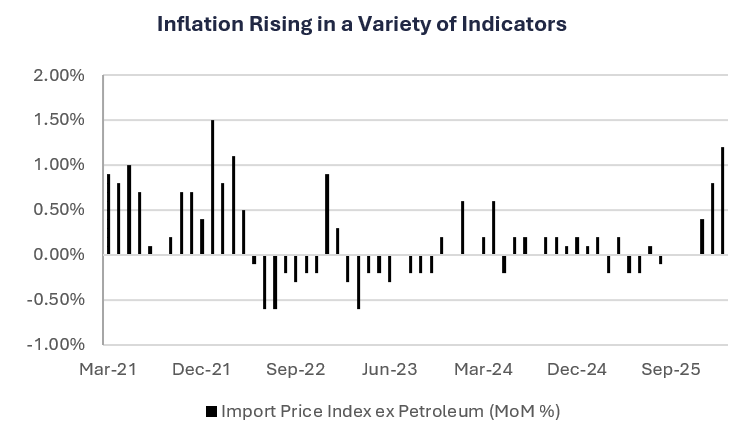
- Import prices are rising most since 2022.
- Regional manufacturing data mixed.
- Global equities fall for fourth consecutive week.
- Treasuries sell off on inflation fears.
- Gold prices continue downward trend.
Weekly Economic Recap — Inflation a Concern in Labor Costs and Imports
The Chicago Fed National Activity Index showed that economic activity in the region declined in February. The weakness was led by the labor market and sales/orders.
Construction spending declined in January for the first time in four months. The weakness was primarily due to spending on residential buildings as spending on construction of nonresidential buildings was flat.
The final reading on nonfarm productivity and unit labor costs showed that labor costs rose more than originally reported in 4Q. The rise in unit labor costs is worth watching as it can be an inflation indicator.
Business conditions in the Richmond region improved to a seven-month high in March. Strength was seen in capex spending and the labor market.
Both the Import and Export Price Indices rose more than expected in February. Import prices at the headline level and excluding petroleum both rose at the fastest month-over-month pace since 2022. The rise in import prices is being led by capital goods.
Weekly Market Recap — War Leads to Broad-Based Declines
Equities:
The MSCI AC World Index fell for the fourth consecutive week as geopolitical tensions failed to ease and energy prices continued climbing. The U.S. led the global weakness, especially tech and growth as interest rates rose. The NASDAQ, Russell 1000 Growth and Dow Jones Industrial Average are now in correction territory (a drop of 10% or more). Outside of the U.S., the developed international markets were able to post modest gains led by Europe and the UK.
Fixed Income:
The Bloomberg Aggregate Index fell for the fourth consecutive week as inflation fears continued to rise along with higher energy prices. Private credit fears are spilling into the public market and weighing on high yield and investment grade bonds. Both high yield and investment grade bonds have fallen for the fourth consecutive week and are posting the longest losing streak since 2023.
Commodities/FX:
The Bloomberg Commodity Index rallied for the fifth time in the past six weeks led by energy prices. Crude oil prices surged above $100/bbl, the biggest weekly increase since the War with Iran began.
WATCH NOW: Alternate View Podcast
Data is as of March 2026.
Source: FactSet Research Systems, Verdence Capital Advisors
