
Weekly Investment Insights
S&P 500 CAPE Ratio Warning: Is Equity Euphoria Fading?
Key Takeaways:
- U.S. equities continue to make fresh record highs.
- Surging bond yields should not be ignored.
- Valuations are not as cheap as they may seem.
- Semiconductor surge suggests over optimism.
- We continue to believe the markets are due for a near term correction.
Euphoria Sets in; Be Cautious
The S&P 500 has made 18 fresh records highs this year and the Nasdaq has made 14. Although the U.S./Israel-Iran conflict created a brief headwind for risk assets, AI-driven enthusiasm has reasserted itself pushing valuations to levels that warrant close attention. We realize that the 1Q26 earnings season was strong and helped investors focus on something other than the many changing details out of the Middle East. However, economic data is painting an unclear picture, especially as it pertains to inflation. In addition, there are several indicators that we monitor that suggest equities may be showing signs of complacency. In this weekly insights, we outline some market indicators that suggest caution is warranted.
Surging global bond yields:
There has not been enough attention paid to the surge in global bond yields. While long term yields are rising, alongside inflation, there are other factors that should be monitored. The 10YR UK GILT has jumped to the highest level since 2008 due to domestic political uncertainty as Prime Minister Starmer faces increased scrutiny. The Japanese 10YR yield has jumped to the highest level since 1997 due to fiscal concerns and rate hikes. In addition, in the U.S. the 10YR yield has broken above the psychological 4.50% level and is at a 14-month high. Historically, higher yields pose a risk to high P/E sectors (e.g., tech).
Valuations concerning for future returns:
A lot of the enthusiasm around equities has been that P/E expansion is not driving the returns in 2026, instead earnings are driving it. However, when you look at the S&P 500 P/E valuation on a cyclically adjusted basis (CAPE ratio=compares price to average corporate earnings over past 10 years and adjusts it for inflation) it is concerningly high. At 40x earnings, it is at the highest level since 2000. In addition, historically when this multiple is between 30-45, the forward five year return of the S&P 500 is ~1% annually.
Semiconductor surge:
The Philadelphia Semiconductor Index has increased over 50% since April. This is one of the largest moves higher in such a short time frame in history. In addition, the Relative Strength Index of the benchmark had breached 80 (a level of 70 is overbought).
Bottom Line:
The U.S. economy is doing well considering record low consumer confidence, a resumption in inflation and a war in the Middle East. However, disciplined investing means considering the price you pay for an investment given its risk. At this time, the U.S. equity market is moving on momentum and not fundamentals. In addition, the current inflation environment should not be ignored. Bonds are alerting investors that inflation is a significant risk and equity investors should be aware that higher yields and inflation can cause P/E contraction. We continue to expect a near term correction to adjust for these dynamics. We will continue to evalute valuations but believe the broad equity market is stretched at this time.
LISTEN NOW: Markets With Megan
Your Economic and Market Detailed Recaps
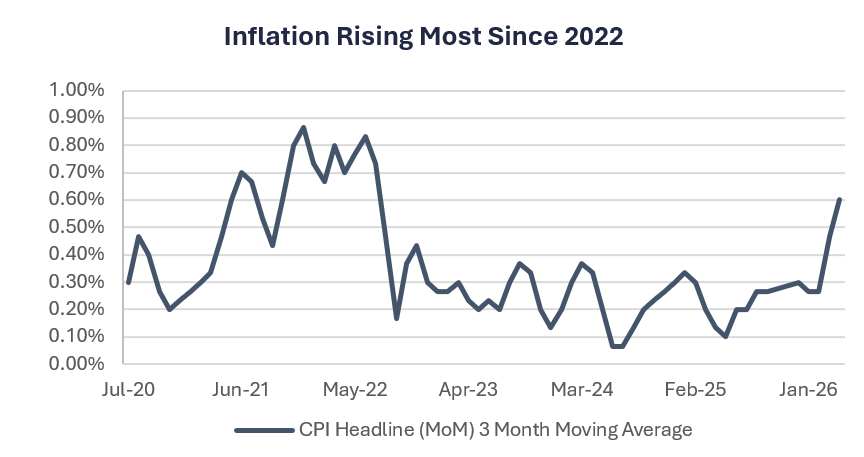
- Inflation growing at fastest pace since 2022.
- Retail sales resilient; not adjusted for inflation.
- Business owners expecting to raise prices.
- Global equities fall as yields rise; tech weakens.
- Yields rise on a jump in inflation data.
- Oil prices surge on lack of progress with Iran.
Weekly Economic Recap — Inflation data proves troublesome while consumers continue to spend
Inflation as measured by the Consumer Price Index came in as expected in April (+0.6% MoM). Inflation is now rising at the fastest three month moving average since July 2022. At the core level, inflation rose 0.4% (MoM), the highest since January 2025. Services, which is the largest component of core inflation rose the most since January 2024 (+0.6% MoM). Housing inflation rose as the owners equivalent rent jumped the most since April 2023 (+0.5% MoM).
Inflation as measured by the Producer Price Index came in much higher than expected at all levels that are analyzed. Energy drove the headline number to grow at the fastest pace since March 2022. When excluding food, energy and trade, prices grew 0.6% (MoM) led by services.
Retail sales rose for the sixth consecutive month in April led by spending on gasoline. When excluding gas, food, autos, and building materials, sales were driven by spending on electronics, internet spending and sporting goods. It is important to note that this data set is not adjusted for inflation.
The NFIB Small Business Optimism Index rose modestly in April. However, the gain was led by business owners expecting to raise prices in the future. Sentiment around future earnings trends and those seeing it as a good time to expand were weak.
Weekly Market Recap — Global equities fall as yields rise on inflation fears
Equities:
The MSCI AC World Index fell for the first time in three weeks as inflation data spooked investors. Globally, the U.S. was the only major index to post a positive return (i.e., S&P 500). A strong U.S. dollar hampered international returns. In addition, a pullback in the semiconductor trade dragged on returns in EM Asia. Within the U.S., the S&P 500 posted a small gain but small and midcap stocks fell sharply as yields rose on inflation data.
Fixed Income:
The Bloomberg Aggregate Index posted its worst one week decline since the week of liberation day (April 2025) as inflation data and lack of progress on the Strait of Hormuz sent yields higher. Long term Treasuries, investment grade and EM bonds led the weakness.
Commodities/FX:
The Bloomberg Commodity Index rose for the third time in the past four weeks. The lack of progress on reopening the Strait of Hormuz sent oil prices back above $100 bbl. Gold prices posted their worst one week decline in eight weeks as yields surged and the dollar strengthened.
WATCH NOW: Alternate View Podcast
Data is as of April 2026.
Source: FactSet Research Systems, Verdence Capital Advisors
