
Weekly Investment Insights
Themes for 2026 – Hedging the Dual Risk Era
Key Takeaways:
- 2026 market outlook
- Economic expansion to continue with little room for error.
- Stop and go can go both ways.
- The stock market is not the economy.
- Growing debt, shrinking tolerance.
- Hedging the dual risk era.
Themes for 2026 – Hedging the Dual Risk Era
As we move into 2026, our base case is that the economic expansion will continue. The supportive factors include past accommodative monetary policy, a generous U.S. tax package, fiscal stimulus around the world, easing trade tensions and continued spending on artificial intelligence. We are not complacent either about the risks that may challenge our view. Reflation risks may be underappreciated and could impact interest rates and equities that are at or near record highs. An AI overbuild, policy uncertainty and geopolitics also pose risks. Below we outline our themes for 2026 for the economy and asset classes.
Economic Expansion to Continue with Little Room for Error:
The economic expansion should continue due to pro-growth government policies (globally) and ongoing capex spending. From a global perspective, we are also seeing stimulative policies in many major global economies.
Stop and Go Can Go Both Ways:
It is difficult to believe the consensus view that all the stimulative measures that are being taken globally, changes to trade policies and continued economic growth will not cause inflation in 2026. We think the Fed will be on hold in 2026 and there is more of a chance of a rate hike than cut.
The Stock Market is not the Economy:
We enter 2026 underweight global equities. We believe valuations fully reflect the economic expansion and the euphoria over AI while overestimating the ability for central banks to cut rates. Investors will also want to see the AI capex spending translate into earnings to warrant the heightened valuations. Investors should get used to more volatility and returns to be driven by earnings growth vs. multiple expansion.
Growing Debt, Shrinking Tolerance:
We believe bonds play an important role as a portfolio diversifier, but our appetite for bonds, especially long term bonds has diminished. We think the risk of reflation is not being reflected in interest rates at current levels. We recommend being short duration compared to the benchmark and being selective within that exposure (i.e. defensive).
Hedging the Dual Risks:
We continue to like alternatives in the private (for qualified investors) and public space. Hedging strategies are important for all investors when the risk of a valuation correction is high. In addition, we believe real assets are important for investors in a period where inflation is a risk.
The Bottom Line:
We realize that we are in a very uncertain time and investors’ anxiety may be high. We remain constructive on the U.S. economy and global equities for the long run, but we cannot warrant chasing equities at these levels. We admit that overbought conditions can go on longer than most expect. That is why discipline is crucial. The over optimism around economic growth, inflation and interest rates is extreme and susceptible to disappointment. We will continue to monitor the economy, interest rates and inflation and adjust as we see necessary. However, currently, we believe asset allocation warrants a very defensive stance, with the use of hedging strategies where necessary.
LISTEN NOW: Markets With Megan
Your Economic and Market Detailed Recaps
- Small business optimism ticks higher.
- Inflation delivers minimal surprises.
- Consumer continues to spend at a solid pace.
- Global equities higher led by international equities.
- Bond yields rise on better-than-expected economic data.
- Geopolitical tensions fuel rally in gold.
Weekly Economic Recap — Is Inflation Behind Us?
The NFIB Small Business Optimism Index rose slightly more than expected in December (99.5 vs. 99.2). The main area of strength came from sentiment around a better economy and net compensation.
Inflation as measured by the Consumer Price Index came in as expected in December (+0.3% MoM) while core CPI rose 0.2% (MoM). While gasoline prices fell, energy services drove inflation higher, primarily utility services. In addition, services excluding energy are rising 3.0% (YoY).
New home sales fell for the first time in three months in October (-0.1% MoM). However, at a 738K annual pace, sales are hovering near a three year high. Sales in the south rose sharply while the other regions fell. The median price of a new home dropped for the sixth month in 2025 and to the lowest level since July 2021.
Retail sales rose at a solid pace by nearly every metric in November. Excluding volatile items like food, gas, autos and building materials sales are growing at a 3.9% pace on a three month annualized basis. Sales rose the most on autos, building materials, at gas stations and on sporting goods and clothing.
Inflation as measured by the Producer Price Index was relatively unchanged at the core (ex food and energy) and headline levels. However, when excluding food, energy and trade, prices jumped 0.7% (MoM) and are rising 3.5% on a year over year basis. Finished goods prices saw their biggest monthly increase in two years which can suggest inflation.
Initial jobless claims fell below 200K for the first time since November and only the third time in the past two years. In addition, the four week moving average of jobless claims dropped to the lowest level in a year.
Weekly Market Recap — International Equities Outperform U.S. Tech
Equities:
The MSCI AC World Index was higher for the second consecutive week but it was international equities that led the gains. The S&P 500 was lower for the second time in the first three weeks of the year as investors rotated out of tech names and into small and midcap equities. The Russell 2500 and 2000 both rallied for the week. From a global perspective, it was Japanese equities that performed the best as the prime minister announced a snap election. Investors view the chances of stimulative fiscal policy due to the snap elections as high.
Fixed Income:
The Bloomberg Aggregate Index was lower for the second time in the past three weeks as solid data on the consumer and labor market reduced the odds of a Fed rate cut at next week’s meeting. High yield, municipals and emerging market debt all rose modestly.
Commodities/FX:
The Bloomberg Commodity Index was higher for the second time in the past three weeks. Gold prices rose to a fresh new record high on increased concern about the U.S. actions in Greenland. Crude oil dropped as the chance of a U.S. strike on Iran dissipated.
WATCH NOW: Alternate View Podcast
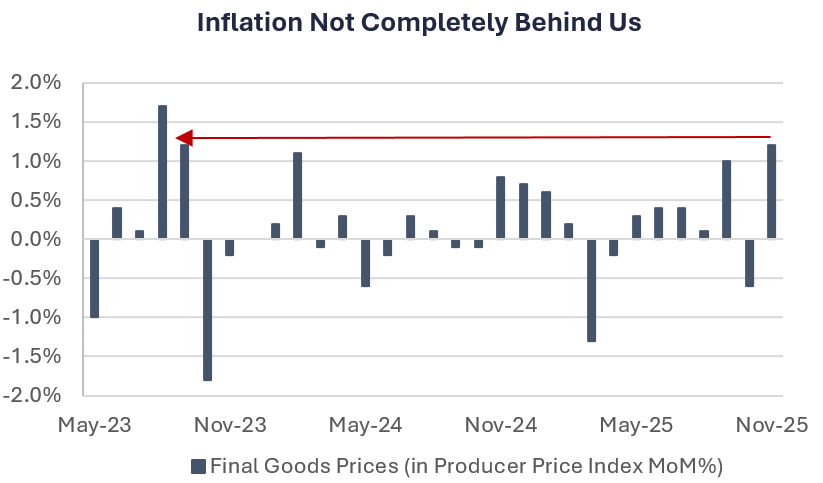
Data is as of November 2025.
Source: FactSet Research Systems, Verdence Capital Advisors
