
Weekly Investment Insights

Welcome Year Four of the Current Bull Market

October 20, 2025

Key Takeaways:

  • Welcome to year four of the current bull market!
  • History suggest bull market has room to run.
  • Volatility should be expected at this stage of the bull market.
  • Renewed credit fears.
  • Discipline is crucial as above average returns may be borrowing from future.

Welcome to Year Four of the Current Bull Market!

Last week we officially entered the fourth year of the current bull market which began on October 12, 2022. The first week of the fourth year run was met with one of the top five longest government shutdowns since the 1970s. Renewed credit fears as two regional banks fell victim to a fraudulent loan scheme. On and off again tariff rhetoric that has kept investors wondering about economic growth. Lastly, momentum exhaustion as the PE (NTM) of the S&P 500 was trading 70% above the average seen at the start of the fourth year in the past three bull markets that made it this far (25.2x vs. 14.8x average). In this weekly insights, we will discuss historical bull market performance and compare it to the current bull market. We will also discuss the factors that are contributing to volatility (as measured by the VIX Index) jumping to the highest level in five months.

How long do bull markets last:

Going back to the 1930s, we observed 14 different bull markets and they have lasted, on average, ~four years. The longest being the bull market that started in March 2009 and lasted until the pandemic induced bear market of 2020. The current bull market has seen the S&P 500 rise ~90% which is slightly higher than the average of the past bull markets that made it into a fourth year (average ~80%). The good news is that nine of the 14 bull markets we observed continued through a fourth year. However, of those nine, this bull market saw a larger than average rise in years two and three (35% and 14%, respectively vs. average of 8% and 6%, respectively).

Government shutdown:

As of today, this shutdown is the third longest (19 days) since we started keeping records (1976). The Senate is scheduled to hold another vote today but there was not much negotiating over the weekend.

Renewed credit fears:

Regional banks are in the spotlight after a few banks (e.g., Jefferies, Zions, Western Alliance) wrote down loans tied to bankrupt auto suppliers and/or fraudulent loans in the commercial and industrial space. The S&P 500 Regional Bank Index has fallen nearly 10% this month. This has ignited fears of another regional banking crisis like Silicon Valley Bank in 2023.

Tariff uncertainty…again:

The U.S. and China are once again going head to head over trade. China’s export controls on rare earths have spurred the White House to impose additional tariffs. The White House and China have several meetings scheduled in the coming weeks to discuss the recent escalation in tariffs.

The Bottom Line:

History would suggest this bull market could continue into a fourth year with solid returns. However, investors should realize this bull market has been stronger than most in the initial years and with valuations stretched, the returns may be borrowing from future potential. Especially as we navigate through an economy that is slowing and highly dependent on the AI capex spending boom. In addition, the recent surge in volatility reminds us that valuations well above average (S&P 500 PE at 25x) may be complacent at this stage of the bull market. It is important to remain disciplined and not overpay for investments that are not rewarding investors for the risk (e.g., credit, select technology).

LISTEN NOW: Markets With Megan

Your Economic and Market Detailed Recaps

  • Small business owners’ optimism falls to three-month low.
  • Homebuilder sentiment improves on lower mortgage rates.
  • U.S. budget deficit decreases (YoY) to $1.78 trillion.
  • Global equities rally despite late-week volatility.
  • U.S. 10YR yield falls to lowest level since Oct. 2024.
  • Gold prices rally as investors flock to safe havens.

Weekly Economic Recap — Taking a Global Look at Data as U.S. Government Shutdown Continues

U.S. small business owners’ optimism fell to a three-month low in September according to the NFIB Small Business Optimism Index. Five of the 10 Index components decreased for the month. The net share of firms that viewed their inventories as “too low” fell by the most since 1997. The uncertainty gauge increased to the highest level since February.

China’s exports increased at the fastest pace in six months in September (8.3%, USD terms) and imports surged the most since April 2024 (7.4%, USD terms). Exports to the U.S. fell 27% in September, while imports from the U.S. fell 16% as the two countries continue to work through trade tensions.

Consumer prices in France increased 1.2% in September, but remained well below the ECB’s 2% target. Services prices increased 2.4% led by health care costs.

U.S. homebuilder sentiment, as tracked by the NAHB Housing Market Index, increased to its highest level since April (37) as lower mortgage rates started bringing buyers to the market. Sales expectations in the next six months increased to the highest level since the start of the year, while prospective buyers’ traffic increased to the highest since April.

The U.S. budget deficit fell in FY’25 to $1.78 trillion, $41 billion (2.2%) less than in FY’24. Tariff collections of $202 billion during the year helped offset a record $1.2 trillion outlays for interest on the federal debt.

Weekly Market Recap — Global Equities Rally Despite Regional Bank Weakness

Equities:

The MSCI AC World Index was higher for the second time in three weeks despite negative trade-related headlines, dovish Fed commentary, and regional bank weakness. All major U.S. averages finished the week higher with growth/technology outperforming in the large cap space. Small and midcap stocks continued to rally with the Russell 2500 Index posting its best weekly performance in eight weeks. Developed markets outperformed their emerging market peers as China equities were sharply lower as the U.S./China trade tensions escalated.

Fixed Income:

The Bloomberg Aggregate Index was higher as bond yields fell on the late-week regional banking concerns and dovish comments from Fed officials. The yield on the U.S. 10-year Treasury hit the lowest level since October 2024 on the basis of the headlines. All sectors of fixed income were higher.

Commodities/FX:

The Bloomberg Commodity Index was higher for the third time in four weeks. Gold prices were higher by the most since April, finishing the week above $4,200/oz., as investors continued to flock to the safe-haven amid uncertain U.S./China negotiations and the regional bank weakness.

WATCH NOW: Alternate View Podcast
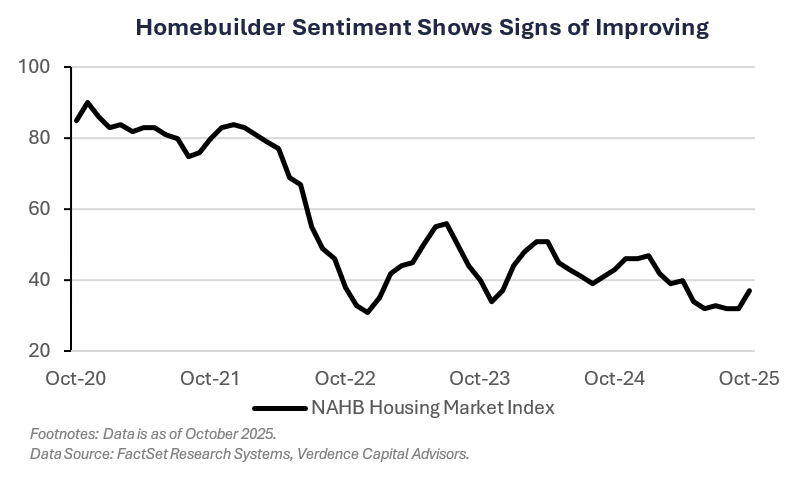
chart current bull market


Data is as of October 2025.
Source: FactSet Research Systems, Verdence Capital Advisors

Disclaimer: © Verdence Capital Advisors, LLC

Reproduction without permission is not permitted. The indexes presented are unmanaged portfolios of specified securities and do not reflect any initial or ongoing expenses nor can it be invested in directly. An investment’s portfolio may differ significantly from the securities in the index.  This material was prepared by Verdence Capital Advisors, LLC (“VCA” or “we”, “our”, “us”). VCA believes the information and data in this document were obtained from sources considered reliable and correct and cannot guarantee either their accuracy or completeness. VCA has not independently verified third-party sourced information and data. Any projections, outlooks or assumptions should not be construed to be indicative of the actual events which will occur. These projections, market outlooks or estimates are subject to change without notice. This material is being provided for informational purposes only and is not intended to provide, and should not be relied upon for, investment, accounting, legal, or tax advice. Past performance is not a guarantee of future results. Different types of investments involve varying degrees of risk, and there can be no assurance that the future performance of any specific investment, investment strategy, or product or any non-investment related content, made reference to directly or indirectly in these materials will be profitable, equal any corresponding indicated historical performance level(s), be suitable for your portfolio or individual situation, or prove successful. You should not assume that any discussion or information contained in this report serves as the receipt of, or as a substitute for, personalized investment advice from VCA. Alternative investments are designed only for sophisticated investors who are able to bear the risk of the loss of their entire investment. Investing in alternative investments should be viewed as illiquid and generally not readily marketable or transferable. Investors should be prepared to bear the financial risks of investing in an alternative investment for an indefinite period of time. Due to various factors, including changing market conditions and/or applicable laws, the content may no longer be reflective of current opinions or positions. All indexes are unmanaged, and you cannot invest directly in an index. Index returns do not include fees or expenses. Sector Watch Use of this website is intended for U.S. residents only. Any recommendation, opinion or advice regarding securities or markets contained in such material does not reflect the views of Verdence Capital, and Verdence Capital does not verify any information included in such material. Verdence Capital assumes no responsibility for any fact, recommendation, opinion, or advice contained in any such research material and expressly disclaims any responsibility for any decisions or for the suitability of any security or transaction based on it. Any decisions you may make to buy, sell, or hold a security based on this research will be entirely your own and not in any way deemed to be endorsed or influenced by or attributed to Verdence Capital. It is understood that, without exception, any order based on such research that is placed for execution is and will be treated as an UNRECOMMENDED AND UNSOLICITED ORDER. Further, Verdence Capital assumes no responsibility for the accuracy, completeness, or timeliness of any such research or for updating such research, which is subject to change without notice at any time. Verdence Capital does not provide tax, or legal advice. Under no circumstance is the information contained within this research to be used or considered as an offer to sell or a solicitation of an offer to buy any particular investment/security. Fixed income securities are subject to increased loss of principal during periods of rising interest rates. Fixed income investments are subject to various other risks including changes in credit quality, market valuations, liquidity, prepayments, early redemption, corporate events, tax ramifications and other factors. Lower rated securities are subject to greater credit risk, default risk, and liquidity risk. Commodity‐related products, including futures, carry a high level of risk and are not suitable for all investors. Commodity‐related products may be extremely volatile, illiquid and can be significantly affected by underlying commodity prices, world events, import controls, worldwide competition, government regulations, and economic conditions, regardless of the length of time shares are held. Data is provided for information purposes only and is not intended for trading purposes. Verdence Capital shall not be liable for any errors or delay in the content, or for any action taken in reliance on any content. Weekly Insights/Qtrly & Annual Outlook The indexes presented are unmanaged portfolios of specified securities and do not reflect any initial or ongoing expenses nor can it be invested in directly. An investment’s portfolio may differ significantly from the securities in the index. Semi-Annual Chart Pack Where shown, performance information presented is that which has been calculated and presented by an unaffiliated third-party manager. We have no insight into the performance of the advisor/product/account or fund shown and do not attempt to determine whether the performance presented is accurate. Therefore, the performance could be incorrect, overstated or not reflective of actual trading of client funds. There is the potential that the performance shown is a back test and not the result of real investment advice and trading. As such, it could not be relied upon as indicative of future returns of a particular strategy. Where performance shown is that of a pooled account, limited partnership, or private equity fund, you should be aware that there is a significant lack of transparency into the operations and investment process and investment vehicles invested in. As a result, pricing and valuation of the underlying holdings which produced the stated performance could be incorrect, stale, or overstated and therefore the performance figures presented cannot be relied upon. Before investing, we encourage you to request additional information, particularly performance information, of any product that you are considering for your client. You should read, as applicable, the Prospectus, SAI, Composite Disclosure and/or performance disclosure associated with any product that you are considering for investment for your or your client’s. Products shown may have minimum account sizes or minimum investments which may preclude retail and non-high net worth investors from being able to invest in these products. You should be aware that certain LPs may be closed to new investors and therefore your clients may be prevented from investing in these products. Portfolio Implementation and Rationales The SMA Asset Allocation Models do not represent a personalized recommendation of a particular investment strategy to you or your clients. You should not buy or sell an investment without first considering whether it is appropriate for your client’s portfolio. Additionally, you should review and consider any recent market news. All expressions of opinion are subject to change without notice in reaction to shifting market conditions. Data contained herein from third-party providers is obtained from what are considered reliable sources. However, its accuracy, completeness or reliability cannot be guaranteed. Supporting documentation for any claims or statistical information is available upon request. Examples provided are for illustrative purposes only and not intended to be reflective of results you can expect to achieve. Diversification and asset allocation do not ensure a profit and do not protect against losses in declining markets. Any forecasts contained herein are for illustrative purposes only, may be based upon proprietary research and are developed through analysis of historical public data. Investments in growth stocks may experience price volatility due to their sensitivity to market fluctuations and dependence on future earnings expectations. Sector allocation references to market capitalization (“smid cap” or “micro caps” etc.) may be subject to special risks given their characteristic narrow markets, limited financial resources, and less liquid stocks, all of which may cause price volatility. International/global investing can involve special risks, such as political changes and currency fluctuations. These risks are heightened in emerging markets. A significant percentage of the underlying investments in aggressive asset allocation portfolio investments have a higher-than-average risk exposure. You should consider your risk tolerance of each of your clients carefully before choosing such a strategy. An investment with multiple underlying investments (which may include asset-allocation or custom blended investments) may be subject to the expenses of those underlying investments in addition to those of the investment itself. Investments may reside in the specialty category due to 1) allowable investment flexibility that precludes classification in standard asset categories and/or 2) investment concentration in a limited group of securities or industry sectors. Investments in this category may be more volatile than less flexible and/or less concentrated investments and may be appropriate as only a minor component in an investor’s overall portfolio. Investment Managers You and your clients should carefully consider investment objectives, risks, charges, and expenses of Funds discussed. This and other important information are contained in the respective Fund prospectuses and summary prospectuses, which should be read carefully before investing. Investment portfolio statistics change over time. Current performance may be lower or higher than return data quoted herein. The investment return and the principal value of an investment will fluctuate; so, an investor’s shares/units, when redeemed, may be worth more or less than their original cost. Verdence relies heavily on unaudited third-party data. Data sources include public data, such as mutual fund data, and non-public data, such as information provided by other investment advisors and managers of limited partnership pooled accounts. Data and/or statistics included on this Portal, including references to performance, opinions, ratings, rankings, manager statistics and demographic information, product, or strategy descriptions, either quantitative or qualitative, are based upon information reasonably available to us as of the applicable date(s) then-published. Information has been obtained from sources that we believe to be reliable, but these sources cannot be guaranteed as to their accuracy or completeness. All data and information produced by a third party has the potential to be incorrect, incomplete, or otherwise misleading. No implication shall be created that the information contained on the Site is correct, including as of any time subsequent to the publish date, and Verdence does not undertake an obligation to update such information at any time after such date. Verdence makes not warranty or representation of the veracity of the data and information and its use of the information should not be implied as an endorsement of any material or statements made. Data, particularly non-public data, is subject to error and where the information is not audited, the potential for error is greater. Where shown, performance information presented is that which has been calculated and presented by an unaffiliated third-party manager. We have no insight into the performance of the advisor/product/account or fund shown and do not attempt to determine whether the performance presented is accurate. Therefore, the performance could be incorrect, overstated or not reflective of actual trading of client funds. There is the potential that the performance shown is a back test and not the result of real investment advice and trading. As such, it could not be relied upon as indicative of future returns of a particular strategy. Where performance shown is that of a pooled account, limited partnership, or private equity fund, you should be aware that there is a significant lack of transparency into the operations and investment process and investment vehicles invested in. As a result, pricing and valuation of the underlying holdings which produced the stated performance could be incorrect, stale, or overstated and therefore the performance figures presented cannot be relied upon. Before investing, we encourage you to request additional information, particularly performance information, of any product that you are considering for your client. You should read, as applicable, the Prospectus, SAI, Composite Disclosure and/or performance disclosure associated with any product that you are considering for investment for your or your client’s. Certain products shown may have account minimums or minimum investment sizes that are unattainable for your clients and therefore they may not be eligible to invest in these products. Reference to registration with the Securities and Exchange Commission (“SEC”) does not imply that the SEC has endorsed or approved the qualifications of Verdence or its respective representatives to provide any advisory services described on the Site.

Read more